|
|
|
| " nomen est omen " is
considered certainly to this section of my homepage. Here I
would like to light up the reproduction in mixed cooperations
a little bit nearer and which purposes the person pursues with
it. |
|
|
lthough itself likely each can present
something under hybrid and crossbreeds, is this one nevertheless
quite interesting subject. With these animals it is about
combinations from tiger, lions and leopards. I disregard all
other big cats in case of this consideration.
The animals appearing
with such crossings have got own names. So the hybrid between
tiger and lion have two different names, according to which
to which sort the father or the mother belonged. If the father
is a tiger and the mother a lioness so one speaks from / of
a tigon. Vice versa we speaks from / of a liger.
The single place in which such a mating
in natural way to state could come is the already mentioned
Gir Forrest national park. There, however, no tigers live.
A tigon or liger is a "product" of humans. However, a crossing
of tiger and leopard can be found in the nature, because these
both big cats divide a habitat. The size difference may be
therefore priority ("biggest") problem. However, such a mating
is improbable extremely, but possible. To the naming I can
only say that ybrids between lion and leopard are named leopons.
A hybrid between tiger and leopard are generally named tigard.
Because no case is known where a leopard the father is there
is for such offspring no designation. However, pargon is in
the conversation for any offspring.
Certainly, a case
is known with a tiger leopards had fertilized, but living
descendants were never born, because the leopards suffered
a premature infant - this was in Hamburg-Hagenbeck. Other
reports on such hybrid also exist, however, can not be classified
as credibly. Tigon and liger were bred mainly in zoologic
gardens and were held. Special mention approaches, in this
connection, the zoos Hamburg-Stellingen and Munich-Hellabrunn.
Generally you finds more liger than tigons in zoos.
The characteristic
features the hybrid in itself combine are tendentious honour
to the father more like than those of the mother. Certainly,
I dare to doubt that one can do such statements on the basis
of the relatively low experiences with such animals, accepts
this knowledge, however, now as given. Near the usual stocks
to be expected how the combination of the fur samples and
some of the other characteristic features appear, however,
still of far more interesting phenomena.
The most obvious
one is the so-called heterosis-effect (with ligers). To some
expert this notion from the botany may be trusted. Here, indeed,
he means the same, namely crossbreed growth or gigantism.
Their parents excel the hybrid first generation mostly enormously.
With higher generations the crossing course must be considered
very exactly around predictions to hit. For example, it can
become difficult to hybrid between tiger and lion absolutely
more than one half metric ton, this is sometimes more than
both parents together on the balance bring. Tigons, however,
incline honour to the dwarfism. Besides awake liger faster
than their parents, while tigons grow slower.
A long time the
infertility fundamental of all hybrid was also postulated.
How Prof. P. Leyhausen proved not later than in 1950, it was
real only a postulate. Certainly, a trend is unambiguously
to the infertility with first of all male hybrid to recognize
(on mistake with the spermiogenese to lead back), nevertheless,
can not be spoken by a general infertility. All male mammal's
crossbreeds have this problem. Cause and background for this
frequent infertility are unanswered still as far as possible,
but here the genetic engineering undoubtedly will be able
to remove soon also some vagueness.
In spite of these
circumstances we can conclude that tigers and lion are phylogenetic
not so closely applied as we could think. How already the
dominant characteristic features one of the parents assert
themselves mentioned with certain characteristic features
again. However, a multiplicity appears intermediately and,
therefore, can not be categorized obviously as similar to
lions or similar to tigers. Measurements in the skull are
a classic example for this. Near the fact that one can breed
to hybrid of the big cats still the question why one positions
itself this should do. The professional world states mainly
arguments like relationship clarification and descent research.
This knowledge is
classified curiously higher in their priority than you at
first sight could think. However, to all scientific brash
pressure to against there also is far of "world" motives for
such crossings. First of all in variety and curiosity shows
were and are very popular these hybrid. The fewest guests
of such show do to themselves seriously thought about an animal
this looks like an extra large lion with tiger's patrols.
The acceptance that these animals are objectionably found
also in the free nature and therefore nothing in it is to
be placed here to the show, moreover, seems to be very spread.
The scientific
efforts with this affair are under circumstances on the edge
of the acceptance, but the breeding for reasons of the pure
trade is definitively not acceptably. In the age of the genetics
not only zoologists are interested in a successful crossing.
Just also geneticists are often fascinated by such experiments,
because the researches are regulated in other higher developed
living beings, like primates, by severe and "well" controlled
set.
A very frequent
justification for such doubtful experiments is smooth and
simply the fact humans can it. The reason is near thinly also
still of the silliest that can be given. Not everything what
people can do is earned to be done. This problem brings to
me, now and then, headaches because do to things very much
is difficult for my own intentions faithful to remain. Although
we should not exaggerate it with ethical intentions, there
is to breed no reason such hybrid for not scientific purposes.
By the way, mentioned there is also a border from the also
scientific considerations are exhausted and it no other reason
for such experiments exist.
|
|
|
Liger:
Usually, only the normal-colored tigreses with a normal-colored
lion were mated or have paired off. But some people had brought
together in the past also aimed lion with white tigreses,
the reason was to be received naturally a white liger. In
similar to white ones they mate gold tigreses (tabbies) with
lions to get around a gold liger. Liger itself is a general
name is not belonged to a scientific counterpart, but you
find frequently in books word things like Panthera leotigris.
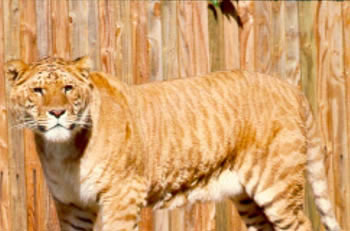
How already from me farther at the top suggested some ligers
show big similarities with lions, while other show very strongly
their tiger's descent. Tendentious the fur of a liger is provided
with the light brown fur colouring of a lion. The tiger skin-rigid
on this tonic are mine not continuously, but splited and reunite.
The form of a candle comes to this picture most like. First
of all in the head area the patrols change so strongly that
these like points seem. These points likely touch from the
lion successor, because the lions have a point-drawing after
the birth also in the fur, this hardly seems to disappear
with a liger with the age. With the eye spots of the tiger
there are with the liger no regularities. It is a chance whether
he does or does not got this or just like with the frill of
a tiger.
However, the sounds can heared with a liger, are not only
similar to lions or only similar to tigers, also there appears
no intermediate vocabulary. Indeed, it is so that a liger
disposes of the complete vocabulary of a lion and a tiger.
You can also hear the lion roaring from a liger, but without
lion-typical "grunt" sound at the end.
Marks mentioning that the biggest cat living today is a liger.
In the guiness book of the records a liger with 590 kilos
is led. The most heavy amurtiger who was ever measured (no
scientific voucher and therefore by me nowhere else specified)
brought approximately 500 kilos on the balance. A liger, standing
on his back legs, is raised about 4 m.
Particularly is striking that a liger (or ligress) inherits
evidently the preference for water. But it seems always so,
as if they had to convince innerly, the lion page in them
to go of to the water. In a zoologic garden a lion herd with
a liger was observed how the lions the liger asked to go in
the water to bring back a prey-/feed-piece out of the water,
which had be throwen in. Unfortunately, no other information
is known to me moreover.
However, ligresses are not barren else as a liger so frequently,
why one has undertaken other crossing attempts also with them.
If by chance a terrible liger should reproduce, certainly,
this is improbable (however, possibly), was worked in in the
reproduction table correspondingly (liger with ligress proves
logically again a liger/ligress):
|
father:
|
mother:
|
offspring:
|
|
|
|
|
lion
|
tiger
|
liger
|
|
lion
|
liger
|
li-liger
|
|
tiger
|
liger
|
ti-liger
|
|
liger
|
tiger
|
ligter
|
|
liger
|
lioness
|
ligon
|
(the last two lines are improbable and naming not uniformly
fixed, but differently among the researchers)
In the Munich zoo Hellabrunn lived till few
years a ligress (15 years old) which came together with
a lion and so actually a li-liger was born. Unfortunately,
I have no information about the whereabouts. However, generally
these are rather a bad posture, also a human mistake which
such connections not seeming in the nature happen. Up to
short ones it was not recognized scientifically which there
can be such hybrid. So tigreses with a lion were held together
and was born up to the moment with the small liger, it was
held by the zoo director for impossible that such a thing
is possible. Certainly, it is not possible to expel that
there was in the past to game / free liger, but there exists
no proof to this day.
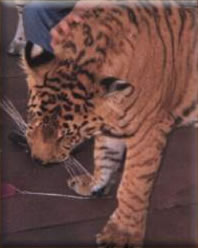
(male ti-liger, approx. 6 months old)
|
|
|
Tigon:
A Tigon is the contrary of a liger, and this even from different
points of view. The parents are exact in reverse order as
with the liger. Besides tigons do not incline to dwarfism
and like the liger to gigantism. Also tigons are to be held
essentially more difficult, also the mating of the parents
is essentially more complicated. Today there exists no protected
proof that there is a living tigons, but approximately 10
tigons are in private attitude.
From the size a tigon as a rule does not reach the size of
the parents. Big tigons have mostly the masses of a very small
tiger or a big lioness. Certainly, there are also exceptions
of this rule, but these are rare extremely. They can not measure
with lions or tigers (only with lionesses and tigreses), never
mind with a liger or a ligress. In numbers a tigon weighs
about 155 kilos.
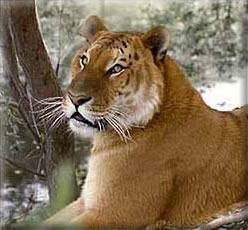
(feminine tigon, approximately 2 years old)
There is vested proof of the existence of tigons from the
year 2000. Against end of the year became a brother and sisiter,
which were born in a circus, were held for a few days in the
Australian national zoo. The animals were probably confiscated
because of the bad attitude conditions. But they had arranged
himself with the circus to the tigons and some of the tigers
from the zoo can in a private enclosure, because the zoo has
no capacities, they said. I got no further information about
the whereabouts.
But present information from this private station seems that
there aime possibilities to breed tigons. This pair tigons,
I mentioned at the top, certainly, paired off with each other,
but never became grew again produced. Also should have been
tried there tries with liger, li-ligern and other big cats.
However, in my eyes this should not be the real sense, but
it forces itself the thought which should be bred there also
with support of celebrated researchers in the area of the
reproduction scholar aimed tigons and other hybrid. And the
temptation as a single zoo world-wide holding tigons could
to also bring the Australian National zoo in the spell of
that- but that is only my private opinion.
I would like, following ones for the Liger, show the reproduction
table. Also in this case it is extremely improbable that a
male tigon is possible as a father, but some notions have
formed which also find no bigger acknowledgment and are applied
only by separate researchers (tigon + tigon = tigon):
|
father:
|
mother:
|
offspring:
|
|
|
|
|
tiger
|
lioness
|
tigon
|
|
lion
|
Tigon
|
li-tigon
|
|
tiger
|
tigon
|
ti-tigon
|
|
tigon
|
tigreses
|
tigor
|
|
tigon
|
lioness
|
tilion
|
(the last two lines are improbable and naming
not uniformly fixed, but differently among the researchers)
How a liger the tigons inherit a preference for water, but
less problems seem to have far also actually in the water
go. From this exception and the size, as well as ripe speed,
seen liger and tigon seem to develop themselves identically.
Also tigons do tiger and lion sounds and study occasionally
also a small mane. However, like with the liger can not keep
up with the mane of a "normal" lion. If the manes of the hybrid
are much more modest actually than this normally the case
with lions is.
The other hybrid of the tigons are computationally 75% of
tiger and only 25% of lion. At this level it is so, that the
descendants if actually, only very much few lion characteristic
features study. From the appearance they are therefore almost
not from normal tigers to distinguish. However, they are to
be recognized furthermore simply by the fact that they also
give to typical lion sounds of themselves. Other abnormalities
of "normal" tigons does not confess at the moment.
From the early years of the septuagenarians of the last century
reports about tigons from the zoo are known in Calcutta. There
it was also aimed tigons tries to breed. And this also succeeded.
The proof are Rudhrani (1971) and Rangini (1974) - both female.
However, atypical for tigons Rangini resembled in the appearance
more of a lioness than one tigreses. Her sister on the contrary
truely already essentially more similar to tiger. The mother
was incidentally an African lioness and no Asian one.
Then Rudhrani was crossed aimed farther with a lion. And
before her death in 1983 she had given about seven li-tigons
the birth. Similar experiments were also planned for Rangini,
but changes in policys (protection of endangered species)
to the moment as she was ripe for gender, regarding of the
efforts of Indira
Ghandi, stopped these crossing attempts. However, it remains
the dull peculiar flavour that the zoo canceld the experiments
officially because there no possibility to breed fertile male
offspring and the parents from Rangini and Rudhrani died.
However, only in 1985 a decree was remitted in India that
these cultivation attempts refused to tolerate. Only few years
after this decree the circle also shut around Rangini, because
she succumbed to a cancerous disease. However, in contrast
to her sister she had had never to suffer under the stress
of crossing attempts (like her sister). At least this is happy!
Reports on the birth of an extremely rare ti-tigon also exist
in the Indian Shambala Preserve. At that time it was supposed
erroneously that also all feminine tigons are sterilely. So
she was spent with an amurtiger together in an enclosure.
How with the case farther at the top with the ligers, the
zoologists and veterinarians thought that offsping was impossible
till 16th september of 1983 - than the little ti-tigon Nathaniel
was born.
I mention this case because he is something quite special
also for other reasons. Although Noelle (tigon) "spoke"
the tiger's language as well as the lion language and she
only "talks" to Nathaniel in the tiger's language.
And in spite of the erbes of his mother Nathaniel could understand
only the tiger's sounds and did not control the lion language,
but he developed a mane. Both succumbed nine years after Nathaniels
birth to the same cancerous disease.
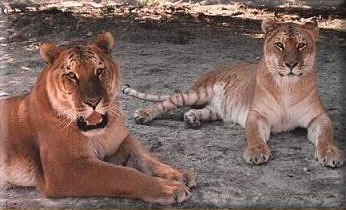
(Nathaniel on the left, Noelle on the right)
|
|
|
The big cat-hybrids between tiger and lion
seem to be able to keep up from the life expectancy here rather
with the normal tigers or lions. Also the immune system seems
to function in most cases faultlessly. But we can see die
ligers, tigons as well as the other hybrid increases in recording
by cancer. The cause is fine in the fact to think that the
DNA of the hybrid destabilizes faster than this for the usually
case is. The exact genetic backgrounds are as far unexplored.
Nowadays it is "only" possible to be bred hybrid animals
which possess the same number of chromosomes and are more
similar family-genetic than the most of the population. However,
in the field of the genetics progresses are registered so
quickly that it will also soon be possible for animals with
different chromosome number and other genetic distance to
become hybridised - so a scientific expert's assessment. Unfortunately,
at this point my few information were exhausted, for the moment,
but I hope nevertheless something well to have mediated.
|
|
For information about the crossbreeds and
hybrid of the cats or if you should still have questions to
the hybridisation of the tiger, you can write an email to me:
 |
|
|
|
|
 |
|
|
|


